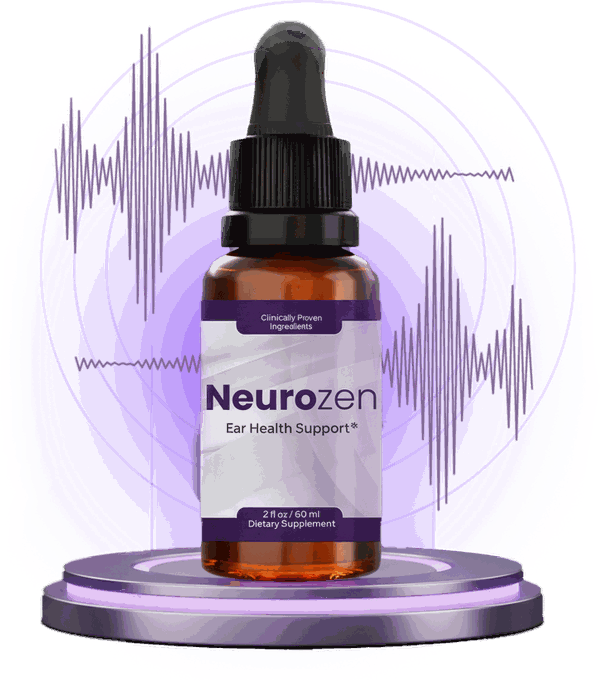
Here is where honesty matters. NeuroZen lists its six ingredients publicly, but it does not publish the milligram amount of each one on its public-facing label, so the doses below are our best estimates for a formula of this type and are marked as approximate. If exact amounts matter to you, the official ingredient label is the place to confirm what the current bottle contains.
Amounts shown are estimates, not label-verified figures. NeuroZen uses a blend and does not disclose per-ingredient milligrams publicly.
Below we walk through all six ingredients, what the research actually says about each one in general, and the role it plays in this specific formula. The references at the end of this review link to independent, authoritative sources on these ingredients.
GABA (gamma-aminobutyric acid)
Estimated 100 mg per dropper
GABA is the main calming, or inhibitory, neurotransmitter in the human nervous system, and it headlines the NeuroZen formula. The thinking behind putting it in an ear-health product is that a nervous system running hot can make ringing feel louder and focus harder to hold, so calmer baseline signaling may make both more manageable. It is worth being straight about the science: research on oral GABA is genuinely mixed, partly because of long-running debate about how much swallowed GABA reaches the brain. Some controlled work reports lower stress markers and a subjective sense of relaxation, while other reviews are cautious. In NeuroZen it functions as the relaxation anchor of the blend, and it is the ingredient reviewers most often connect to feeling less wound up in the evening.
L-Glutamine
Estimated 100 mg per dropper
L-glutamine is the most abundant free amino acid in the body and a building block the body uses to produce both glutamate and GABA, the two neurotransmitters that sit on either side of the excitation-and-calm balance. Most published glutamine research looks at gut lining, immune cells, and recovery after physical stress rather than hearing specifically, so its presence here is best read as supporting the raw material side of the formula rather than as a direct ear remedy. It is well tolerated at the modest amount a dropper delivers, and because the body makes and uses glutamine constantly, it rarely causes complaints. Think of it as a supporting player that feeds the calming pathways GABA works on.
Grape seed extract
Estimated 75 mg per dropper
Grape seed extract supplies a concentrated dose of proanthocyanidins, plant polyphenols with a well-documented antioxidant profile. The rationale for an auditory formula is circulatory: the inner ear depends on a rich, delicate blood supply and on cells that are vulnerable to oxidative stress, so ingredients studied for vascular and antioxidant support show up often in this category. According to the National Center for Complementary and Integrative Health, grape seed extract has been studied mostly for cardiovascular measures, with promising but not conclusive findings, and it is generally well tolerated. Inside NeuroZen it plays the antioxidant-and-circulation role, one of the more evidence-backed reasons a botanical earns a spot in a blend like this.
Green tea leaf extract
Estimated 60 mg per dropper
Green tea leaf extract brings catechins, chiefly EGCG, plus trace amounts of the amino acid L-theanine. Catechins are among the more heavily researched dietary antioxidants, and L-theanine is separately studied for a calm-but-alert mental state, which pairs logically with the focus angle NeuroZen markets. NCCIH notes that while green tea has been studied extensively, firm conclusions about most specific health claims are still out of reach, so the honest framing is antioxidant and mild focus support rather than a proven fix. At the small amount a dropper provides there is very little caffeine, which fits the product's stimulant-free positioning. Reviewers who mention afternoon clarity tend to credit this ingredient and the ginseng together.
L-Tryptophan
Estimated 50 mg per dropper
L-tryptophan is an essential amino acid, meaning the body cannot make it and has to get it from diet. It is the precursor the body converts into serotonin and, downstream, melatonin, which is why it is associated with mood and sleep. In a formula aimed at calmer nerves and better rest, tryptophan is a sensible inclusion, and it helps explain why a share of reviewers report falling asleep more easily rather than feeling stimulated. It also comes with the clearest caution in the blend: tryptophan can interact with antidepressants and other serotonergic medication, so anyone on those drugs should clear NeuroZen with a doctor first. MedlinePlus is a good plain-language starting point on what tryptophan does.
Panax ginseng
Estimated 50 mg per dropper
Panax ginseng, also called Asian ginseng, is one of the most studied adaptogens, valued in traditional practice for mental energy and resistance to fatigue. It is the closest thing NeuroZen has to an energizing ingredient, though at a dropper-sized amount it is a gentle nudge rather than a jolt, which suits the no-stimulants promise. NCCIH describes the research on ginseng for cognition and fatigue as ongoing and not yet definitive, and flags that it can interact with certain medications, including blood thinners and diabetes drugs. Within the formula it balances the sedating pull of GABA and tryptophan, which is likely why users describe NeuroZen as calming without leaving them foggy.